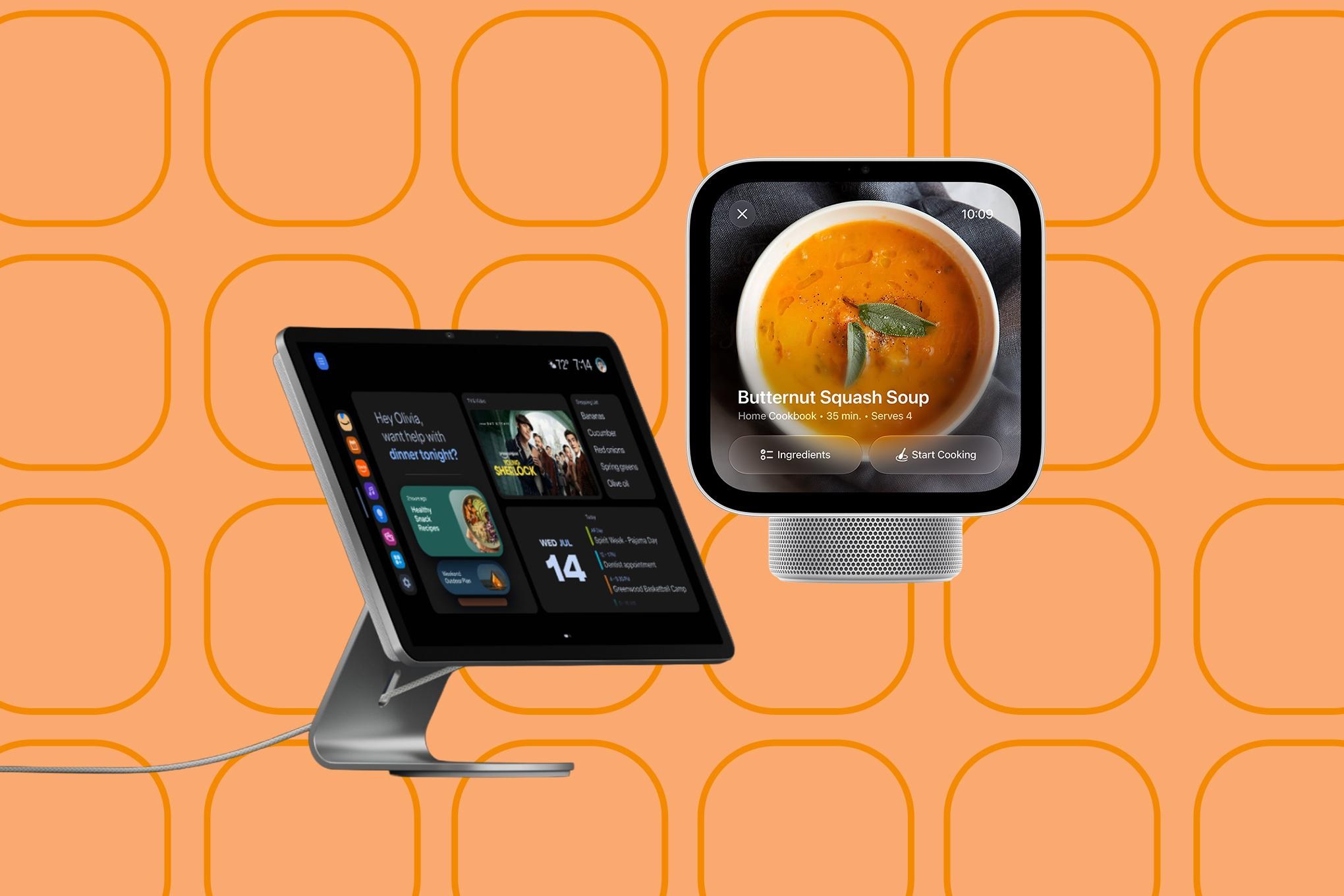
Apple's $299 HomeView and Amazon's $499.99 Echo Show 16 bring computer-class hardware to smart displays, finally making them useful as family computers.
The Smart Display Grows Up
Three years ago, Jennifer Pattison Tuohy wrote an obituary for the smart display. The category—smart speakers with touchscreens attached—was stuck with a few underpowered gadgets from Google and Amazon that tried to do too much and did too little well. Back then, she also laid out what they needed to do to improve. This month, Apple and Amazon launched new smart displays that check nearly every box on that list.
Based on brief hands-on time with Apple's first smart display, the $299 HomeView, and Amazon's $499.99 Echo Show 16—a ground-up rebuild of its smart display line—these could finally turn the smart display into what it should have been all along: the family computer. Not a place to do homework or pay the bills, but a shared screen the whole household can use to check the calendar, see who's at the door, and figure out what's for dinner.
Computer-Class Hardware Arrives
The biggest shift is that both companies have finally brought computer-class hardware to the space. Apple's HomeView runs on the A18 chip—the same silicon found in the MacBook Neo—paired with a Liquid Retina display. Amazon's Echo Show 16 uses a MediaTek processor and the same Nanomatte display as its new Alexa Tablet. This turns a category plagued by underpowered hardware and limited software into devices people might actually want to use.
"This turns a category plagued by underpowered hardware and limited software into devices people might actually want to use."
For years, smart displays were hamstrung by low-end chips and stripped-down operating systems. The result was laggy touch response, limited app support, and a general sense that you were using a compromised device. The new hardware changes that equation entirely. With an A18 chip, the HomeView has more than enough horsepower for smooth multitasking, video calls, and on-device AI processing. Similarly, the MediaTek processor in the Echo Show 16 represents a significant leap over previous Echo Show models.
Two Philosophies, One Goal
Apple and Amazon are taking opposite approaches to reach the same destination. Apple's HomeView leans into the company's ecosystem—tight integration with iCloud, HomeKit, and the revamped Siri voice assistant. The device is designed to feel like a natural extension of the iPhone and iPad, with a familiar interface and seamless handoff between devices. Amazon's Echo Show 16, meanwhile, doubles down on Alexa and the smart home. It's a hub for Matter and Thread devices, a control center for routines, and a window into Amazon's growing ecosystem of services.
Both devices share a common purpose: to serve as a shared family screen. They can display calendars, show live camera feeds from doorbells, play music and videos, and manage smart home devices. But the underlying software and services differ significantly, and that will likely be the deciding factor for most buyers.
The Price Question
The catch is price. In 2023, the Echo Show 5 cost $85 and the Nest Hub $99. Apple's HomeView, the cheaper of the two new models, costs three times that. At $299 and $499.99 respectively, these are premium devices. But these devices now have a much clearer purpose, beyond being a vessel for each company's revamped voice assistant. And with the software to back it up, they might actually be worth the investment.
For families looking for a central hub that can handle video calls, streaming, smart home control, and shared calendars, the HomeView and Echo Show 16 offer a compelling proposition. They are no longer novelty gadgets; they are bona fide family computers. The question is whether consumers are willing to pay computer-like prices for them.