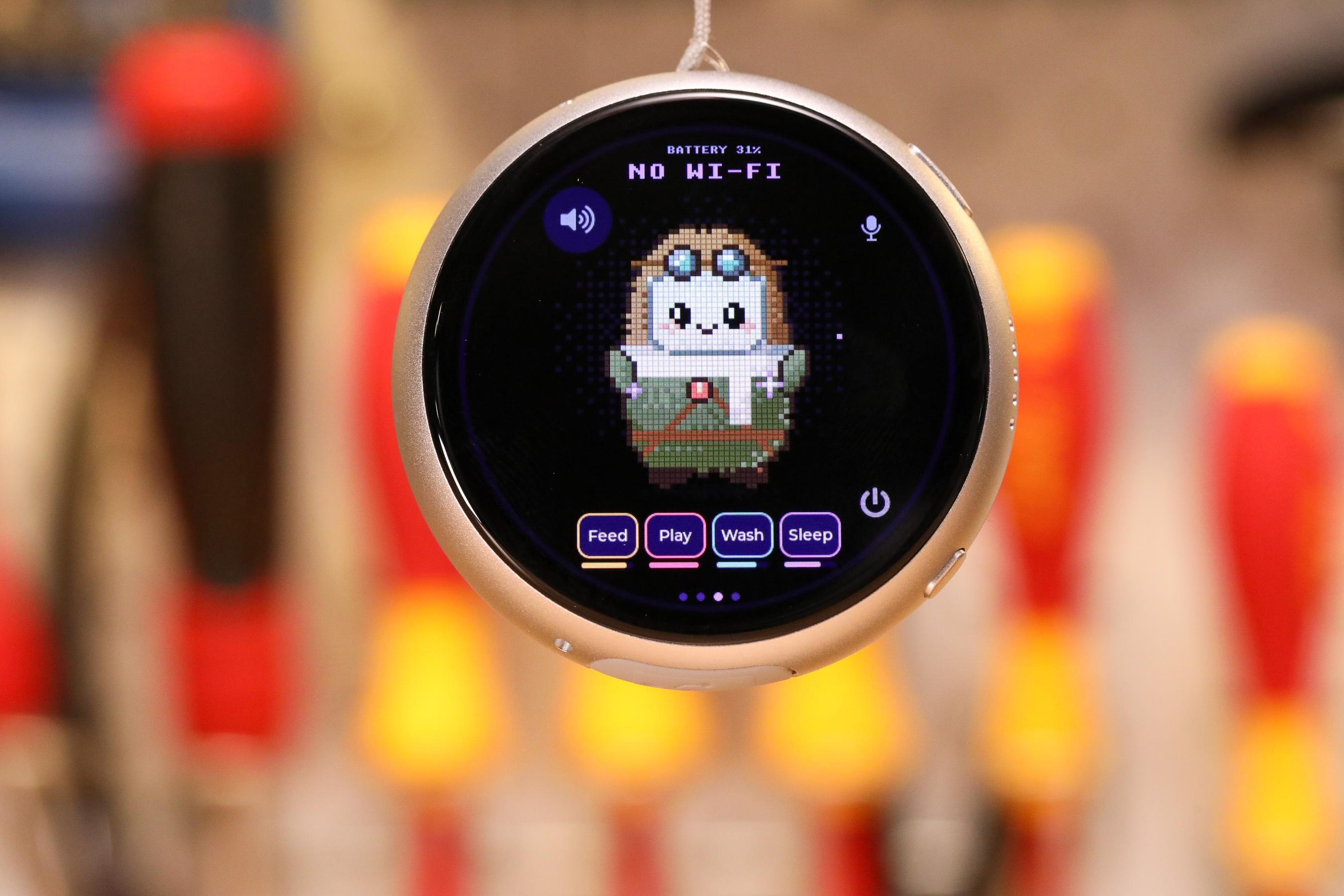
Sean Hollister built a $50 AI Tamagotchi using the Waveshare ESP32-S3 1.75C and Meta's Muse AI, offering a cheaper alternative to the Meta Muse Charm.
The $50 AI Tamagotchi That Challenges Meta's Muse Charm
When Meta CEO Mark Zuckerberg introduced the Muse Charm—a squishy-faced AI companion designed to be carried like a Tamagotchi—it seemed like the must-have gadget of the holiday season. But before Meta could ship its cute AI helper, one intrepid maker proved you don't need to spend big to get a similar experience. For just $50, Sean Hollister, Senior Editor at The Verge, built his own AI Tamagotchi using off-the-shelf hardware and Meta's own open-source tools.
The project centers on the Waveshare ESP32-S3 1.75C, a 1.75-inch touchscreen computer pendant drop-shipped from China. This unassuming devkit not only looks remarkably similar to the Muse Charm but is also officially sanctioned by Meta as one of the first suggested platforms for building a "Muse Gadget"—a device that leverages Meta's open-source code and tokens to connect directly to the Muse AI cloud. The result is a pocket watch-style gadget that talks to Muse, displays cute avatars, and even doubles as a remote camera viewfinder, albeit with some caveats.
Hardware and Setup: A Promising Start
The Waveshare ESP32-S3 1.75C is a compact, silver metal pendant with a 1.75-inch touchscreen. It's powered by the ESP32-S3 microcontroller, which offers integrated Wi-Fi and Bluetooth, making it ideal for IoT and AI applications. Out of the box, the device felt "pretty useless," according to Hollister, but the setup process was straightforward: plug it into a PC, point Claude (an AI coding assistant) at Meta's GitHub repository, and pair it with the Muse phone app.
However, getting the device to actually communicate with Muse required some troubleshooting. Initially, Muse misinterpreted the device's audio input as transcription requests rather than commands. After clarifying the intent, responses remained slow, and the device didn't speak answers aloud. The tiny screen only displayed a few words at a time, forcing users to whip out their phones to read full messages in the Muse app. These limitations highlight the gap between a DIY devkit and a polished consumer product like the Muse Charm.
Meta's Muse Ecosystem: Open but Rough Around the Edges
Meta's decision to open-source its Muse AI and encourage third-party gadgets is a strategic move to build an ecosystem around its AI assistant. By providing tokens and code, Meta enables developers to create devices that connect to its cloud, potentially expanding Muse's reach beyond smartphones and smart displays. The Waveshare devkit is one of the first officially recommended platforms, signaling Meta's interest in fostering a community of makers.
Yet, the experience also reveals the challenges of relying on open-source tools. The setup process, while aided by AI assistants like Claude, still requires significant technical know-how. The "vibe code"—the extra configuration and troubleshooting—can be substantial. For hobbyists, this is part of the fun, but for mainstream consumers, it's a barrier. Meta's Muse Charm, by contrast, promises a seamless out-of-box experience with cameras, 5G connectivity, and a polished interface.
DIY vs. Consumer: The Trade-offs
Hollister's project underscores the classic trade-off between DIY and consumer electronics. The $50 Waveshare device lacks the Muse Charm's cameras and 5G radio, but it costs a fraction of the price and offers a learning experience. It also doubles as a pocket watch and a remote camera viewfinder, and theoretically, it could control smart home devices with additional coding.
- Cost: $50 vs. likely $100+ for the Muse Charm.
- Customization: Open-source code allows for endless tweaks and integrations.
- Performance: Slower responses and limited display compared to the polished Muse Charm.
- Learning curve: Requires technical skills and patience.
For those willing to tinker, the ESP32-S3 devkit is a capable platform. It features a dual-core Xtensa LX7 processor, 512KB SRAM, and 8MB PSRAM, which is sufficient for basic AI tasks. The 1.75-inch touchscreen (resolution likely 320x240 or similar) is adequate for simple avatars and text, though not for rich media. The device also supports Wi-Fi 802.11 b/g/n and Bluetooth 5, ensuring connectivity to Meta's cloud.
"My version doesn’t sport cameras or a 5G cellular radio, but it really talks to Muse and has cute avatars, too! It doubles as a pocket watch and a remote camera viewfinder, and it can (theoretically) control my smart home." — Sean Hollister
What This Means for the AI Gadget Market
The success of DIY projects like this one signals a growing interest in personal AI companions that go beyond voice assistants. Meta's Muse Charm, with its Tamagotchi-like appeal, aims to capitalize on nostalgia and the desire for tangible AI interactions. But as Hollister's experiment shows, the underlying technology is accessible enough for makers to replicate—and sometimes even improve—the concept.
This could pressure companies like Meta to keep their consumer devices affordable and open. It also demonstrates the vitality of the maker community, which can rapidly prototype and iterate on new ideas. As AI continues to permeate everyday objects, the line between DIY and commercial products will blur, empowering users to create personalized AI companions that fit their needs and budgets.
For now, the $50 AI Tamagotchi remains a compelling proof of concept. It may not have Meta's polish, but it captures the essence of what makes AI fun: a little bit of magic, a lot of curiosity, and the willingness to get your hands dirty. Whether you buy a Muse Charm or build your own, the era of pocket-sized AI friends is officially here.