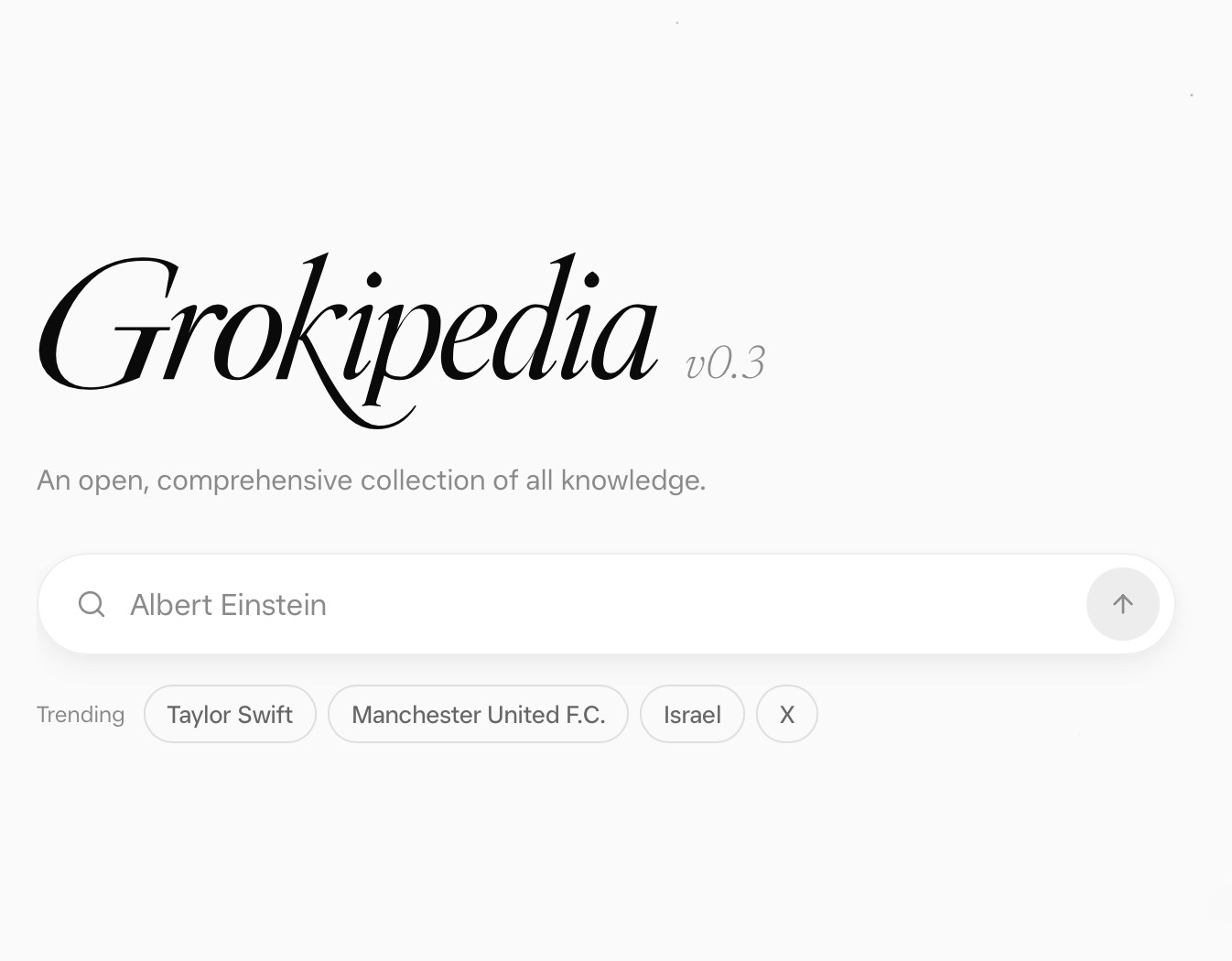
Grokipedia's v0.3 update adds a new logo, a featured-articles homepage, a book-shelf most-read view, and a rebuilt live edits page after months of stalled edits.
Grokipedia Gets a 'Newly Refreshed' Look
\nGrokipedia, the AI-powered encyclopedia positioned against Wikipedia, is showing signs of life once more. After recently resuming edits following months without changes, the site picked up a set of visual updates as part of a v0.3 release. The update covers a new logo as well as refreshes to the homepage and the live edits page. SpaceXAI head of design Benji Taylor described the result simply as a \"newly refreshed Grokipedia.\"
\nThe change is notable less for its scope than for its timing. A redesign is a product decision, and shipping one implies that somebody inside SpaceXAI is still investing attention in the project after a stretch in which the encyclopedia looked effectively abandoned.
\n\nFrom Search Bar to Front Page
\nThe previous Grokipedia homepage was, by the site's own standards, extremely spare: essentially a logo and a search bar. The v0.3 version turns it into something closer to a conventional editorial front page. Key additions include:
\n- \n
- A list of featured articles, presented as digital representations of books that can be spun around in the browser. \n
- A most-read section that reuses the book metaphor as a horizontally scrolling shelf of \"book\" spines. \n
- A tracker surfacing the \"latest edits\" directly on the landing page. \n
The book-spine conceit is a deliberate piece of identity work. By borrowing the visual language of a physical reference library, Grokipedia is signaling that it wants to be read as a durable knowledge artifact rather than a raw AI output stream.
\n\nLive Edits and Article-Level Tweaks
\nThe rebuilt live edits page makes it easier to see more of the recent changes at once, a meaningful usability shift for anyone trying to judge how active the site actually is. Article pages received a smaller set of adjustments: the key-facts tables at the top of entries now use a nicer-looking format, and line spacing between lines of text has been tightened. Beyond those changes, articles themselves look largely the same.
\n\nA Version History With a Long Gap
\nGrokipedia first launched as v0.1 in late October 2025, built on AI-cloned pages sourced from Wikipedia. A v0.2 update landed roughly a month later. Then, earlier this year, the project appeared to stop making updates altogether, prompting scrutiny from outside observers. Lawfare published a report in August stating bluntly that \"As far as we can tell, no entry has changed in more than three months.\"
\nAs far as we can tell, no entry has changed in more than three months. — Lawfare\n
Given the recent resumption of edits and this v0.3 release, it appears there is renewed interest inside SpaceXAI in Grokipedia. The company did not immediately reply to a request for comment.
\n\nWhy the Redesign Matters
\nFor AI-generated reference works, the hard problems are not typography. They are provenance, sourcing, correction velocity, and the ability to prove that a claim changed because a human verified it rather than because a model re-rolled its output. Edit cadence has become the de facto health metric for Grokipedia: a live edits feed is only meaningful if entries actually change, and a most-read shelf is only meaningful if readers trust what sits on it.
\nThe v0.3 update addresses the surface layer competently. The remaining question is whether the underlying pipeline can sustain the update frequency that the new interface now puts on public display.