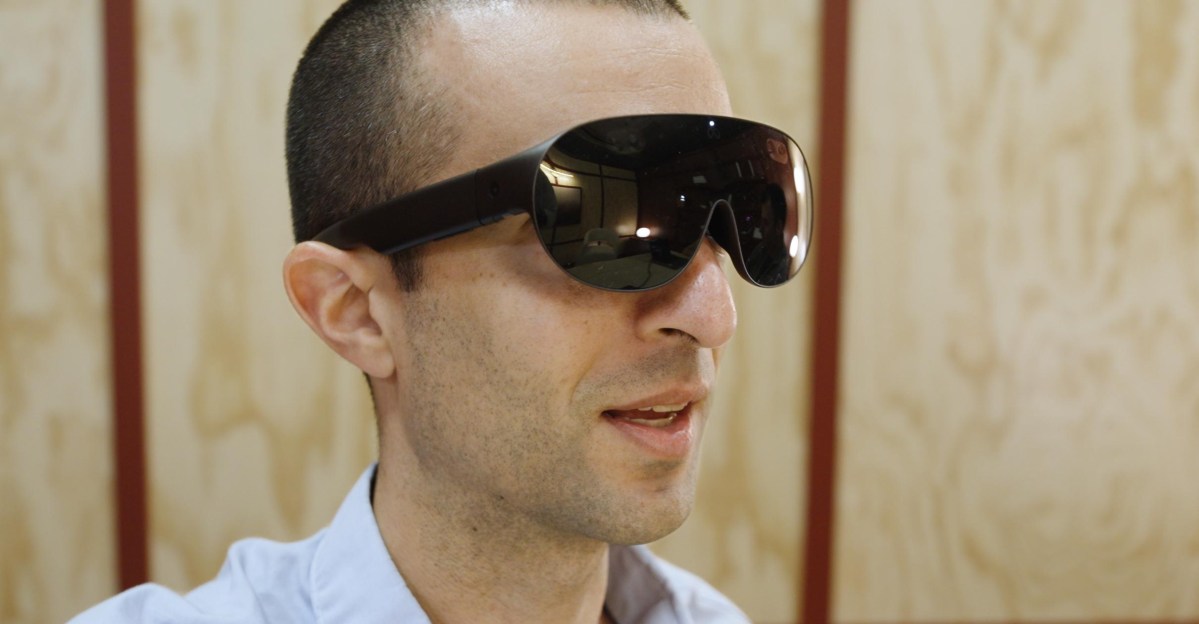
Meta's new VR Glasses pack a 5K MicroOLED display, eye and hand tracking into a 100g frame, with Snapdragon Reality Elite compute in a tethered pocket puck.
Meta's Next VR Device Is Not a Headset. It Is a Pair of Glasses.
Meta has launched new VR hardware, and it abandons the head strap entirely. The new Meta VR Glasses sit on your ears like a normal pair of eyewear while still delivering immersive displays for watching movies, playing games, and getting work done. Picture a hefty pair of black sunglasses with blacked-out lenses, except the internals of a conventional VR headset have been split between the frame on your face and a computing puck that rides in your pocket.
The pitch is straightforward: deliver VR in a far lighter, more approachable form factor than the Apple Vision Pro or Meta's own Quest-style headsets. In a hands-on session at Meta's campus, the difference registered in two ways. One was literal weight: the glasses come in at just 100g, far less than the Quest 3's 515g. The other was intangible. The glasses form factor makes the device feel like something you could jump in and out of rather than a whole cumbersome commitment with big head straps. It reads like a lightweight Vision Pro, and arguably a better execution of some of what Apple wanted to accomplish with that device.
Hardware Split: Frame on the Face, Brains in the Pocket
To keep things light, the VR Glasses put only the display and the sensors on your face. The separate puck, connected by a wire, carries the guts that power the headset.
- Weight: 100g on the face, versus 515g for the Quest 3
- Processor: Snapdragon Reality Elite
- Memory and storage: 12GB of RAM and 128GB of storage
- Battery: up to three hours of media playback, and you can keep using the glasses while the puck is charging
- Display: a 5K MicroOLED "Infinite Display" with 2412 x 2288 pixels per eye, 37 pixels per degree, and a refresh rate of up to 120Hz
- Passthrough: two cameras on the front of the glasses for color passthrough
- Fit: small and large sizes for different widths, at the same price
Eyes and Hands Replace the Controller
Navigation is driven primarily by your eyes and hand gestures. You look at elements onscreen to move around, and the operating system highlights whatever you are looking at using two pairs of eye-tracking cameras. To select a highlighted item, you pinch your thumb and pointer finger together. To scroll, you make a fist and move your thumb around the top of your hand.
The interaction model echoes the gestures used on the Meta Ray-Ban Display, with one important difference: those require a neural wristband, while the VR Glasses instead use six external cameras to follow your hands directly.
Entertainment Looks Like the Strongest Use Case
Based on the demos, the big virtual screen makes the VR Glasses most compelling for entertainment. Meta showed a clip from James Cameron's Billie Eilish concert film, which landed well on a huge virtual display, plus parts of the most recent NBA Finals, captured in a format called VR180 that provides a 180-degree view of the court.
There was also a portion of Avengers: Endgame shown in what Meta characterizes as a "VR Enhanced Cinema" experience built in partnership with Disney and Industrial Light & Magic. The VR environment surrounding the screen carried graphics that thematically matched what was happening in the film and changed as the clip progressed.
When a huge energy beam appeared at a major moment featuring Thor, one shot out at the top of the VR environment as well.
Meta says VR enhanced versions of Avengers: Infinity War and Star Wars: A New Hope will be available when the VR Glasses launch.
Gaming: Hands-First, But Backward Compatible
Gaming remains a major use case. Meta demonstrated a new Beat Saber mode called Flux that supports playing with your hands, though it will also work with the Quest's Touch Plus controllers. Instead of waving virtual sabers to hit blocks in time with the music, Flux tasked the player with moving their hands, each surrounded by balls of energy connected by pulsing electricity, to break through flying poles and smash targets. It makes sense once you play it, and the single song in the demo was genuinely enjoyable.
The VR Glasses will have more than 75 games at launch supporting the new hands-first experience, including a VR version of Phoenix Wright: Ace Attorney - Dual Destinies arriving in 2027. They will also support the entire current Quest app catalog and can connect to Touch Plus controllers as well as Bluetooth controllers.
Work, Multitasking, and a Surprising Typing Demo
Meta is also pitching the glasses as a way to browse apps and do some work, and the vision holds up. In one demo, the glasses mirrored three windows from a nearby laptop. You will be able to connect wirelessly to computers or other devices over a USB-C connection, which could be useful when you want more screen real estate for work.
The most memorable demo of the session was about typing. While using a special Instagram build made for the VR Glasses, the reviewer was prompted to leave a comment on a picture. The comment was typed and the app navigated using a virtual keyboard and trackpad that appeared after laying both hands flat on the table. The virtual keyboard and trackpad turned out to be surprisingly good. The experience is not as speedy as a physical keyboard and mouse, but for a short message or email in a pinch, it could be quite useful. It is worth noting this is not technically new: Meta introduced the feature for Quest headsets earlier this year, though it went untested on those devices.
The Bottom Line
Meta's VR Glasses are a bet that the future of virtual reality is not about strapping more hardware to your face, but about moving most of it somewhere else. By keeping the worn portion at 100g and pushing the Snapdragon Reality Elite, memory, storage, and battery into a tethered puck, Meta gets a device that feels casual rather than committal. Whether that trade-off wins over buyers will depend on how well the puck, the cable, and the eye-and-hand control scheme hold up outside a curated campus demo.